
Listen to Luke Johanni speak about this article on the Mind and Spirit Podcast!
Healing Trauma (Part 1): Explore how Catholic teaching and modern psychology together offer a path to healing.
Our scars aren’t proof of defeat. They’re proof that love can touch pain and bring life out of it.
Hi friends! Welcome back to Mind and Spirit, the podcast where Catholic faith meets psychology and we explore what real healing looks like. I’m Luke Johanni, your Catholic-integrated therapist—helping you bridge faith and mental health so you can find peace, purpose, and restoration.
Don’t forget to subscribe, follow @LukeJohanni on social media, and visit here to submit your questions. They might even be featured in a future episode.
Let’s dive in.
Today begins a two-part series on trauma. In this first episode, we’re focusing on understanding trauma: what it really is, what it does to the body, mind, and spirit, and how it can quietly shape the way we see ourselves, others, and even God.
Trauma isn’t just something that happens to other people. It’s the accident you survived, the betrayal that changed how you trust, the words that still echo years later. It doesn’t only wound our emotions—it rewires the brain, tightens the body, and can even shake our faith (APA Dictionary of Psychology).
In Part 1, we’ll look at how trauma forms and why it affects us so deeply, both psychologically and spiritually. Then, in Part 2, we’ll move into what healing actually looks like: how therapy, faith, and practices like CBT, EMDR, and prayer can work together to restore the whole person.
So take a deep breath, get comfortable, and let’s begin this journey of understanding together.
What Does Trauma do to Us?
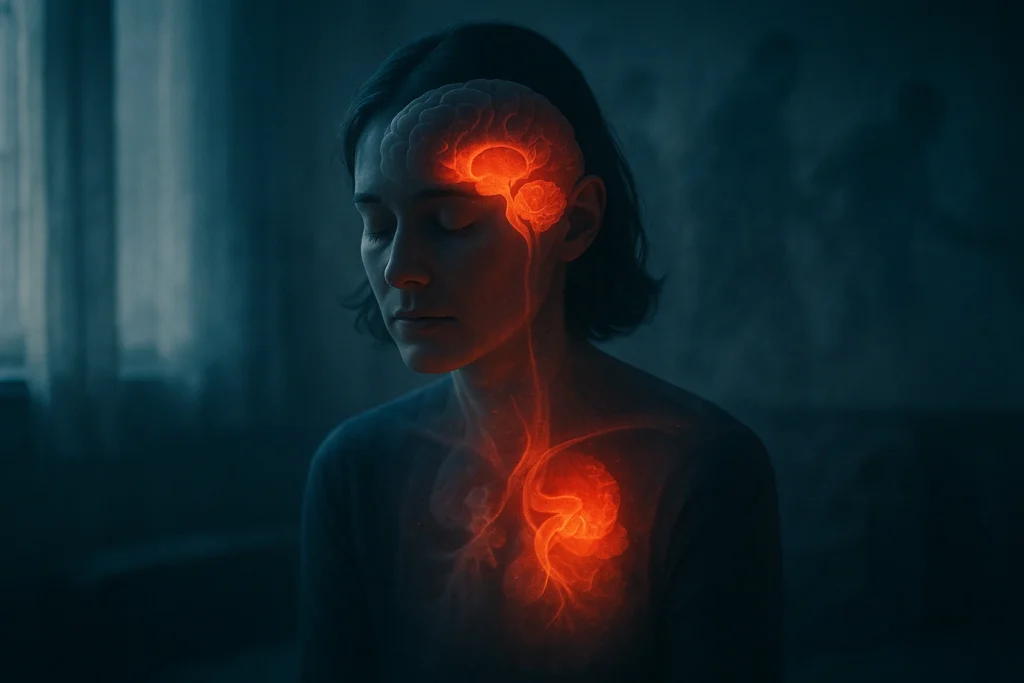
When most people hear the word trauma, they picture a single terrible event: an accident, an assault, a moment of danger. But trauma is actually what happens inside you because of what happened to you (Bessel van der Kolk). It’s the body and brain’s lasting response to something that overwhelmed your ability to cope. And it can come from one big event or from years of smaller wounds: such as neglect, emotional abuse, constant stress, feeling unseen.
Two Minds: The Rational and Reactionary
The reactionary mind can instantly take over. Your heart races, your muscles tense, and stress hormones flood your system. And you’re in survival mode.
Every one of us lives with two operating systems in our brain.
The Rational Mind
The rational mind lives mainly in the prefrontal cortex, right behind your forehead. This helps you think, plan, pray, make decisions, and say, “Wait a second, let’s take a breath.”
The Reactionary Mind
The reactionary mind lives deeper down in what’s called the limbic system, especially the amygdala and brainstem. This is your body’s built-in alarm system. It doesn’t think; it just reacts to keep you alive.
When something threatening happens: like, a car swerves, someone yells, or a painful memory surfaces, the reactionary mind can instantly take over. Your heart races, your muscles tense, and stress hormones flood your system. And you’re in survival mode (NIMH).
Now, that’s a good thing in a real emergency, it’s how God designed your body to protect you. But it is a problem: when trauma happens and that emergency system gets stuck on. The reactionary mind keeps running even when the threat is gone, and the rational mind can’t easily turn it off. You’re left living from instinct rather than reason. It’s the same as the body saying, “Danger!” even when you’re sitting safely at home.
How Trauma Affects the Brain
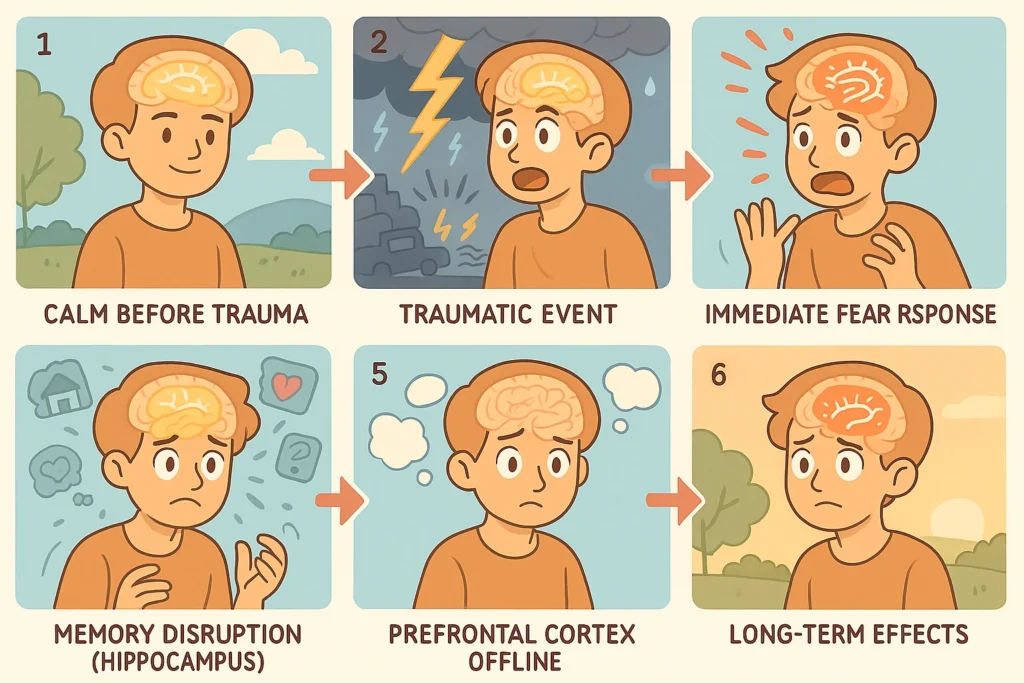
To understand how it works, let’s take a quick tour of your brain’s survival system. There are three main players we’ll talk about: the amygdala, the hippocampus, and the prefrontal cortex. Think of them as the alarm, the storyteller, and the wise guide.
The Amygdala: Your Internal Alarm
Deep inside the limbic system, which is the brain’s emotional center, sits the amygdala. Its job is simple: keep you alive. It scans every sight, sound, and smell looking for threat. When it senses danger, it sounds the alarm, releasing adrenaline and cortisol, your fight-flight-freeze hormones (van der Kolk).
In a real emergency, that’s a gift from God it’s how you jump out of the way of a speeding car or grab your child before they fall. But under chronic stress or repeated trauma, the amygdala becomes overactive. It starts to treat ordinary life as danger. A raised voice, a disapproving look, or even silence can set off the same physiological panic as the original event.
That’s why someone who’s been hurt might feel on edge even in safe situations. The alarm system is doing its job, but it just doesn’t know when to turn off.
The Hippocampus: The Storyteller and Timekeeper
Right next door to the amygdala is the hippocampus. It’s responsible for memory and context. It tells your brain, “That happened yesterday, not right now.” During healthy memory, the hippocampus files events away neatly with a beginning, middle, and end.
But during trauma, cortisol floods the brain, and the hippocampus struggles to keep up. Instead of storing the memory properly, it fragments it. To give a mental image, it’s like a flash of color here, a sound there, a body sensation somewhere else (van der Kolk). Later, when something reminds you of that event, those fragments can surface as flashbacks or emotional flooding. That’s why trauma memories feel alive. They’re not fully integrated into the past; the hippocampus never got to finish its story.
The Prefrontal Cortex: The Wise Mind
Now up at the front of your brain, behind your forehead, is the prefrontal cortex, the most advanced part of the human brain. It handles logic, decision-making, empathy, and moral reasoning. It’s the part that says, “Take a deep breath, think this through, you’re safe.”
Under trauma, though, blood flow leaves this area and rushes to the survival centers. The prefrontal cortex effectively goes offline. That’s why people later say, “I don’t know why I froze,” or “I couldn’t think” (APA – PTSD). In that moment, they literally couldn’t. The thinking brain shuts down so the survival brain can act fast.
As a result:
- The amygdala screams, “Danger!”
- The hippocampus can’t tell whether it’s past or present.
- The prefrontal cortex loses control, and reasoning disappears.
What’s left is pure instinct: fight, flight, freeze, or fawn. It’s not weakness; it’s our designed protective system (van der Kolk).
If you’ve ever thought, “Why can’t I just move on?” It’s not because you’re weak. It’s because your nervous system hasn’t learned that the danger is over.
How This Explains Trauma Symptoms
When the system stays stuck this way, you get the classic trauma symptoms:
- Hypervigilance (always scanning for threat).
- Flashbacks or nightmares (because the hippocampus hasn’t finished filing the memory.)
- Emotional outbursts or numbness (because the prefrontal cortex can’t regulate the amygdala.)
- Difficulty concentrating, trusting, or praying (because the body still feels unsafe.)
Understanding this helps us replace shame with compassion. If you’ve ever thought, “Why can’t I just move on?” It’s not because you’re weak. It’s because your nervous system hasn’t learned that the danger is over.
How Trauma Effects the Body
Over time, our body learns to live in a constant state of readiness, what scientists call hyperarousal.
Trauma doesn’t just live in the mind. It settles into the body. When the brain’s alarm system stays switched on, the whole body prepares for danger that never ends. For instance, your muscles tighten and hold tension as if bracing for impact. Your breathing and heart rate speed up, keeping you on alert even when you’re trying to rest. Overproducing stress hormones begin to disrupt normal rhythms: like, sleep becoming light or restless, digestion slowing or speeding up, and the immune system weakening (NIMH).
Over time, our body learns to live in a constant state of readiness, what scientists call hyperarousal. It’s as if the body has forgotten how to stand down. This can cause you to feel exhausted but unable to relax, tired but wired. And to be clear, that’s not you being “too sensitive”; it’s your body trying to protect you the only way it knows how. Yet, healing invites the body to learn safety again. To breathe, rest, and feel peace without scanning for danger.
How Trauma Affects the Mind
His advice was simple but wise: choose one confessor and obey their direction completely, because jumping from priest to priest only feeds the cycle.
Just as trauma disrupts the body’s rhythms, it also changes how the mind processes thoughts and memories. As mentioned, when the brain is overwhelmed, it can’t file experiences neatly like it usually does. Instead, memories become fragmented (shattered images, sounds, or sensations that pop up without warning). That’s why people experience intrusive thoughts, flashbacks, or sudden overwhelming emotions that seem to come out of nowhere. At other times, the mind swings to the opposite extreme and shuts down completely, emotional numbness, which is a kind of mental fog that protects you from feeling too much.
Both reactions are the mind’s attempt to survive: one by replaying the danger until it’s understood, the other by disconnecting to avoid the pain (APA Dictionary of Psychology). Neither means you’re broken; they mean your brain is still trying to make sense of what happened. Healing involves helping the mind reconnect those pieces, so memories can be remembered rather than relived, and clarity can replace the current confusion.
How Trauma Affects the Spirit
When trauma goes unhealed, it shapes our whole worldview that: People can’t be trusted. I’m always in danger. If I let my guard down, I’ll get hurt again.
And finally, trauma doesn’t stop with the body or the mind, it reaches the spirit. When something shatters our sense of safety or trust, we start to wonder, “Where was God when this happened?”
For many, that question sits quietly in the background, unspoken but heavy. Trauma can distort how we experience God’s presence. Prayer may feel hollow, church may feel unsafe, or faith that once brought comfort can suddenly feel distant. It’s not because you’ve lost belief; it’s because your nervous system is still in survival mode. When your body and mind are fighting to stay alive, it’s hard to feel peace, connection, or divine closeness.
Even the saints wrestled with this; think of Job crying out in his suffering, or Jesus Himself asking from the Cross, “My God, my God, why have You forsaken me?” (Matthew 27:46). Those words remind us that doubt and distress are not signs of weak faith, they’re part of the human experience of pain. Healing the spirit means slowly allowing God back into the story, not as the cause of suffering, but as the One who never left even when we couldn’t sense Him there (Psalm 34:18).
When trauma goes unhealed, it shapes our whole worldview that: People can’t be trusted. I’m always in danger. If I let my guard down, I’ll get hurt again. Understanding this isn’t self-pity. It’s self-awareness. The body remembers what the mind tries to forget.
The Wisdom of the Church
Wisdom in the Catechism
When we bring faith into the picture, the Catechism speaks powerfully about what suffering can mean in the light of God.
Paragraph 1501
In paragraph 1501, it says: “Illness can lead to anguish, self-absorption, sometimes even despair and revolt against God. It can also make a person more mature, helping him discern what is not essential so that he can turn toward that which is.”
Paragraph 1505
In other words, pain can drive us into isolation, or it can strip away the noise and help us see what really matters. Sometimes both happen at once. Then, in paragraph 1505, the Catechism goes even deeper: “Christ not only allows himself to be touched by the sick, but he makes their miseries his own… By his Passion and death on the cross, Christ has given a new meaning to suffering.” That’s the heart of Catholic healing: Christ doesn’t erase pain; He redeems it. When we look at the Cross, we don’t just see a religious symbol; we see trauma written on the body of God Himself.
Jesus was betrayed, beaten, and abandoned. He knows what suffering feels like from the inside. But through the Resurrection, those wounds are transformed. They don’t disappear; they become glorified. Even in His risen body, Jesus still carries His scars. And here’s what that tells us:
Our scars aren’t proof of defeat. They’re proof that love can touch pain and bring life out of it.
Wisdom in Scripture
Christ invites us to bring Him the very wounds we’d rather hide, because that’s where real healing and connection with Him begin.
Scripture echoes this truth again and again.
In Isaiah 43:2, God promises, “When you pass through the waters, I will be with you,” not if, but when. In Psalm 34:18, we’re reminded that “The Lord is near to the brokenhearted and saves the crushed in spirit,” a reassurance that even in our lowest moments, His presence never leaves. And in John 20:27, the risen Christ says to Thomas, “Put your finger here; see my hands,” inviting him to touch the very wounds that once seemed like the end of the story.
Together, these passages reveal a God who doesn’t stay distant from pain but enters right into it by transforming wounds into places of encounter, and fear into connection. Christ invites us to bring Him the very wounds we’d rather hide, because that’s where real healing and connection with Him begin.
Wisdom of the Saints
The Church gives us the why of suffering, Christ’s redemptive love, and psychology often helps us with the how of healing.
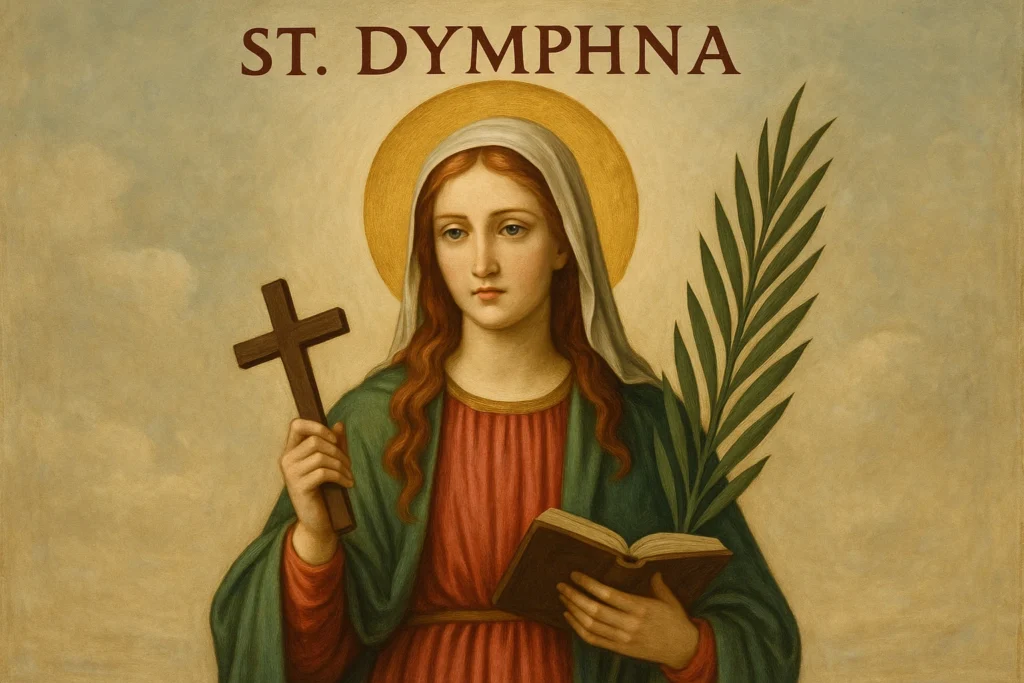
And the Church has given us real people who’ve lived that truth. People whose lives show what it looks like when suffering becomes a doorway to grace. One of the most powerful examples is St. Dymphna, a young woman who faced trauma, loss, and fear but found courage and holiness in the midst of it all.
St. Dymphna’s Story
St. Dymphna’s story is both tragic and deeply hopeful. She was a young Irish princess whose father, overcome by grief and mental instability after her mother’s death, became violent and unsafe. Dymphna fled for her life, refusing to surrender her dignity or her faith. When her father eventually found her, she chose death over sin and was martyred for her purity and courage (Catholic Answers).
St. Dymphna’s Affect
Centuries later, devotion to her grew in the town of Geel, Belgium, where something remarkable happened: instead of hiding those with mental illness away, the people of Geel welcomed them into their homes and families. They lived, prayed, and worked together. It was a model of compassion and community that we might call trauma-informed care long before psychology had a word for it (Psychiatric Times).
St. Dymphna’s Lesson
St. Dymphna’s life reminds us that holiness isn’t about avoiding pain; it’s about refusing to let pain define who you are. Healing begins when we find belonging, dignity, and love even in the aftermath of suffering.
And that’s exactly what good therapy is meant to do. It offers a safe space where our wounds can be named, understood, and tended with care.
The Church gives us the why of suffering, Christ’s redemptive love, and psychology often helps us with the how of healing: how to calm a body that’s stuck in fear, how to retrain a mind that still feels unsafe, and how to rebuild trust one step at a time.
A Closing Invitation
We’ve covered a lot today, from how trauma reshapes the brain and body to how faith helps us see that our wounds don’t have to be the end of our story.
If there’s one thing I want you to take with you from this first part, it’s that what you feel isn’t weakness. It’s your body and mind’s efforts to keep you safe. And even when that safety system gets stuck, God hasn’t left you. He meets you right in the confusion, the fatigue, and the ache. He’s not waiting for you to “get over it.” He’s waiting to walk with you through it.
Next Time
In the next episode, Part 2 of Healing Trauma: With Psychology and Faith, we’ll move from understanding trauma to exploring how healing actually happens. We’ll talk about what recovery looks like through therapy, faith, and belonging: how tools like CBT, EMDR, and prayer can help your mind, body, and soul begin to rest again (CBT Guide – APA; EMDR Therapy – Francine Shapiro). Don’t forget to subscribe, so you’ll be ready for Part 2.
Remember
You are not broken beyond repair. You are seen, held, and deeply loved by the One who heals you.
Prayer
Before we go, let’s close in prayer.
Lord Jesus, You see every listener who still carries the weight of unhealed pain. Bring calm to their racing thoughts and peace to their restless bodies. Remind them that You are not distant from their suffering. You are present in it. Give them the courage to take the next step toward healing, and prepare their hearts for the work You want to do in them. Amen.
Closing
Thanks so much for spending this time with me on Mind and Spirit. If today’s episode spoke to you, don’t rush past it. Take a quiet moment to breathe and let God meet you right where you are.
If this episode encouraged you, I’d love for you to subscribe, leave a review, and share it with someone who might need it. Your support not only helps this show grow. It helps more people find hope and healing through faith.
To connect with me personally, follow and message me on Instagram @LukeJohanni, or visit RestoredChristianCounseling.com for more resources.
And if you have a question you’d like me to answer in a future episode, just head to the Podcast page on my website and submit it. I’d love to hear from you.
I’m Luke Johanni, and this has been Mind and Spirit. Until next time, may the peace of Christ be with you.
Sources/Resources
- The Body Keeps the Score — Bessel van derKolk, M.D.
- Catechism of the Catholic Church §§ 1501
- Catechism of the Catholic Church §§ 1505
- Salvifici Doloris — St. John Paul II
- APA Dictionary of Psychology | TraumaDefinition
- APA — Post-Traumatic Stress Disorder Overview
- NIMH — PTSD and Trauma Basics
- Catholic Answers | St. Dymphna Encyclopedia
- Psychiatric Times | St. Dymphna and the GeelCommunity
- Tabella App Blog | St. Dymphna and theImportance of Mental Health
- CBT Explained — American PsychologicalAssociation
- EMDR Therapy — Francine Shapiro
- The Healing Power of the Sacraments — Fr. JimMcManus, C.Ss.R.
- The Wounded Healer — Henri J. M. Nouwen
- Man’s Search for Meaning — Viktor E. Frankl
- Catholic Therapists Directory
- NAMI FaithNet

How Porn Hijacks Your Life (and How to Break Free)
Authentic Masculinity: Strength Ordered To Love
The Silent Struggle of Men: Finding a New Strength
When God Feels Far: Why You Feel Abandoned and How to Find Him Again (Part 2)
When God Feels Far: Why You Feel Abandoned and How to Find Him Again (Part 1)

Healing Trauma: With Psychology and Faith (Part 2)

Healing Trauma: With Psychology and Faith (Part 1)

Healing Scrupulosity and OCD: A Proven Path of Faith
The Truth About Anxiety: One Size Doesn’t Fit All
Breaking Free from Shame: The Power of Faith and Psychology
Mind and Spirit: From Brokenness to Calling
Have a question? Want it answered?
Submit your question below and it maybe answered on the Mind and Spirit Podcast and in this Blog. If you’d like a personal email response, please include your email.*
*Please note: Submitting a question through this form does not constitute therapy, nor is it intended to. It does not establish or initiate a therapeutic relationship. Learn more in our Privacy Policies.
Follow me on Instagram and Facebook or subscribe to the blog for weekly encouragement.